In the automotive parts supply chain, parts ranging from small screws to large drive shafts need to be certified before they can be manufactured. The division of labor in the supply chain is very clear and demanding. Tier 1 suppliers must undergo stringent certification by vehicle manufacturers before they can be supplied to OEMs for use, Tier 2 suppliers provide modules or parts to Tier 1 for assembly, and Tier 3 suppliers generally provide parts or raw materials to Tier 2 for use.
Tier 1 such as Magna, Denso, Bosch, etc. are responsible for the design and manufacture of various sub-systems, while the panel industry is part of the Tier 2 supply chain; automotive ICs are part of Tier 3.
In recent years, the domesticMinistry of Economic Affairs focuses on the development of intelligent electric vehiclesWith the goal of entering the supply chain of OEMs, we help domestic key system and component manufacturers with development potential to transform and upgrade into Tier1 suppliers of OEMs.
German Tier 1 manufacturers have worked together with well-known automotive manufacturers to codify/revise the automotive cleanliness standard VDA19.1 to achieve consistency in the delivery of parts that are clean enough to avoid damage to the function of the parts from killer particles.
European and American Tier 1 manufacturers mainly focus on transmission systems and safety systems, and pay great attention to safety requirements. Therefore, European and American Tier 1 manufacturers use VDA19.1 as a basis to compile standards that meet their own product requirements, such as ZF Group's ZFN 1132 standard, Bosch's 0140E0111675 standard, Continental's Q1-04-00 standard, etc.... Q1-04-00 standard of Continental....
Often these Tier 1 in-plant standards categorize product types and set different particle/fiber requirements that downstream manufacturers are required to meet to ensure that post-assembly cleanliness meets vehicle manufacturers' needs.
Precision and sensitive components may require a higher level of cleanliness, such as no metallic luster particles of 100 microns can be detected on the surface of the part, or the weight of total contaminants must not exceed 0.1 milligrams for every 1,000 square centimeters of the surface of the part, etc....
Some Tier 1 standards even specify extraction solutions, membranes or test methods to ensure the validity of cleanliness test results. More stringent manufacturers require that the cleanliness test be conducted by an ISO/IEC17025 qualified test laboratory.
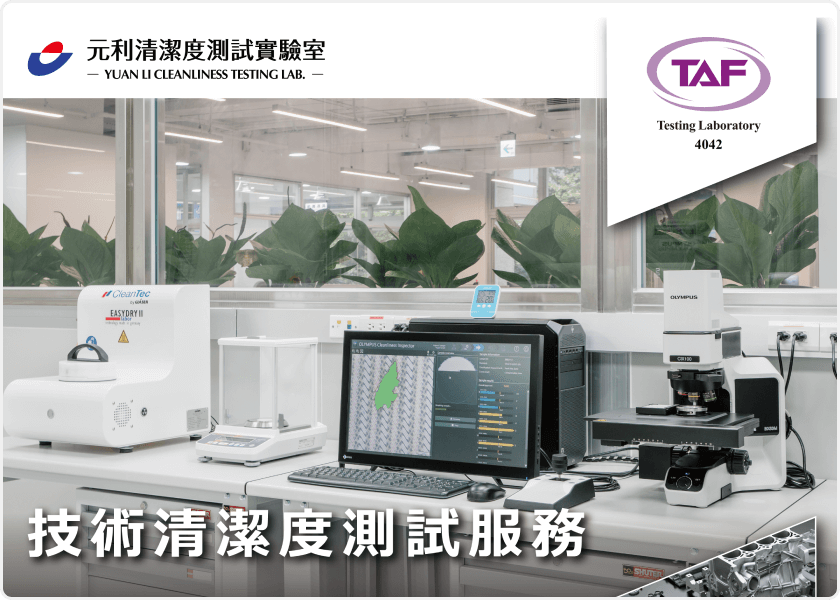
In 2022, Yuanli's cleanliness testing laboratory was accredited by TAF, becoming the first laboratory in China to obtain ISO/IEC 17025 certification in the field of cleanliness testing. We regularly communicate with Evident Optical Analyzer, Gläser cleanliness testing equipment manufacturers and Fraunhofer IPA research institutes in order to provide the latest knowledge on cleanliness. To learn more about our cleanliness services or equipment, please contact us atContact UsAfter filling in the relevant information, the Commissioner will discuss the relevant matters with you.
Author:Cleanliness Laboratory Engineer Yang Shengkai/EditorEditor: Yeung Nga Tong