Lubricants are indispensable to the manufacturing, marine, aerospace, heavy-duty vehicle and energy industries, serving not only the common function of reducing friction, but also sealing and preventing leaks, preventing vibration, cooling and cleaning. However, if dirt, metal particles or other debris builds up in the oil, over time, undetected contaminants can damage parts and evenCauses machine malfunctionThe
For this reason, many facility managers set oil cleanliness levels to control oil contamination. Oil cleanliness is a measure of the amount of particulate contaminants in the oil, which may include insoluble (solid or liquid materials that do not mix with the oil) and hard (e.g., metal shavings) particles.
Grading Criteria
There are two main standards for particle counting to assess the cleanliness of oils, the National Aviation Standard (NAS 1638) and the International Standards Organization (ISO 4406).
NAS 1638
NAS 1638 includes five particle diameter "counting ranges": 5 to 15, 15 to 25, 25 to 50, 50 to 100, and >100 (unit: micron µm). A range of particle counts per 100 mL of fluid is calculated for each particle size, and these count ranges are categorized into contamination levels from 00 (cleanest) to 12 (dirtiest).
However, since the oil is contaminated by particles of different sizes, the degree of contamination of the tested oil sample will be determined by the highest grade of the measured size. Therefore, it is possible that the contamination level of 5 to 15 micron particles may be classified as level 2, while the contamination level of 15 to 25 micron particles may be classified as level 8, making it difficult to determine the exact contamination status.
ISO 4406
ISO 4406 uses three overlapping size categories to rate particles as >4 microns, >6 microns and >14 microns. The number of particles in each of the three sizes is measured per 100 ml of oil sample and graded according to a comparison table.
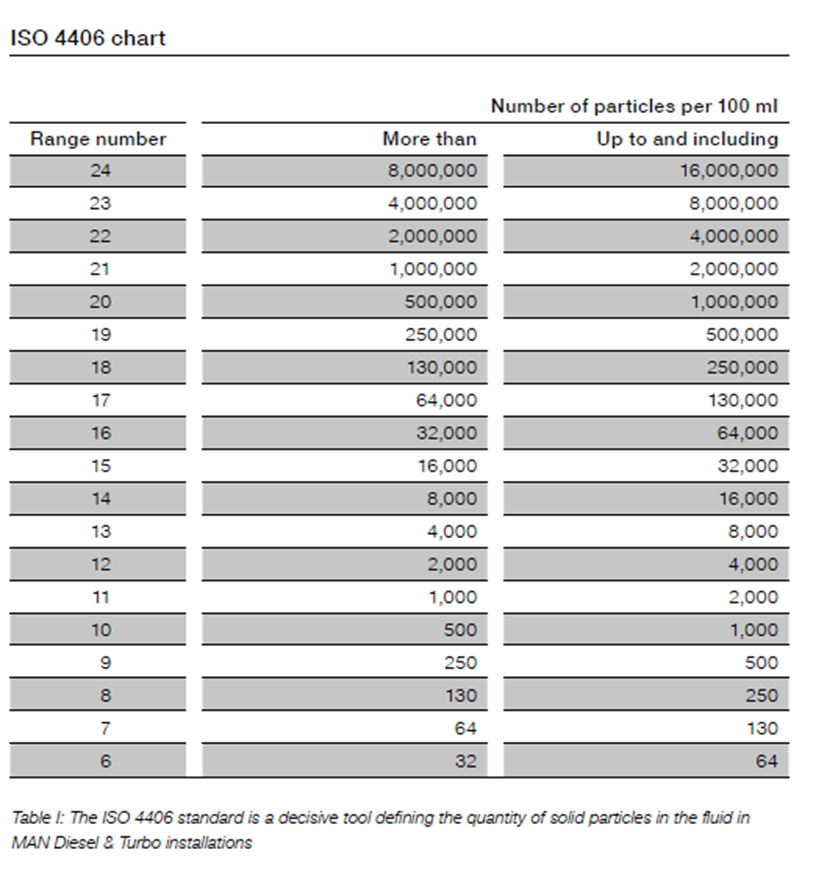
For example, if the number of ≧4µm particles per 100ml of oil is measured to be between 8000~16000, ≧6µm particles between 1000~2000, and ≧14µm particles between 250~500, the oil cleanliness can be labeled as ISO 14/11/9. Since NAS and ISO use different counting methods, there is no precise conversion between the two standards, but only an approximate comparison. Only an approximate comparison can be made.
In order to ensure the smooth operation of the equipment, it is necessary to analyze the oil to show the usage level of the equipment through the oil condition. If you are in need of testing equipment or services, please contact Yuanli Instruments for a complete solution that meets international standards.
Editor: Yeung Nga Tong